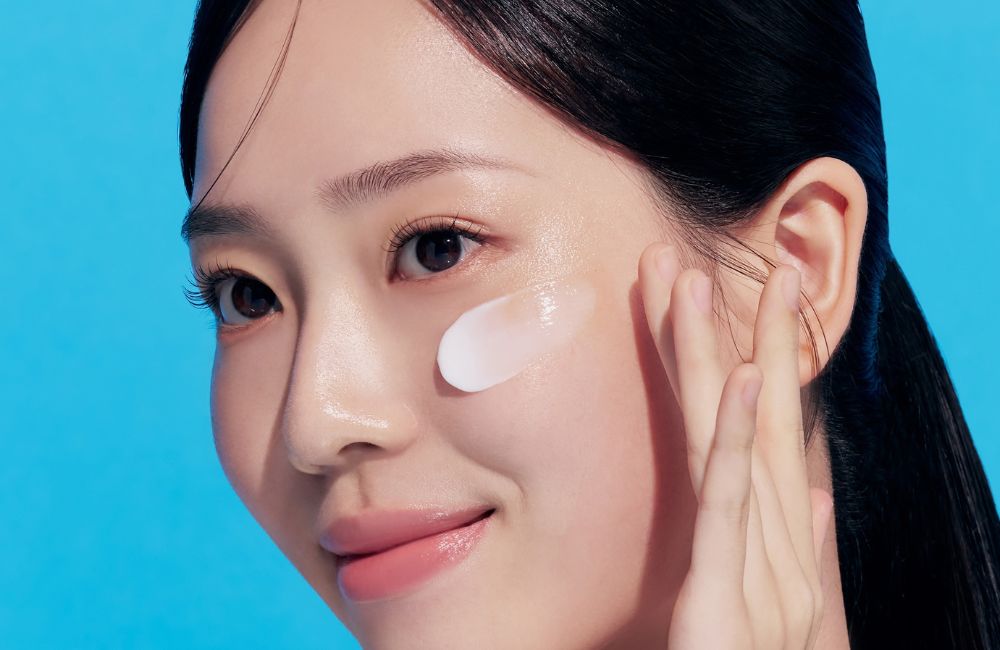
If you have oily skin, you may have thought that moisturizer would only make your face look shinier. However, oily skin also needs hydration - the real question is which moisturizer to choose for oily skin. We'll show you which ingredients and textures to look for, how to incorporate moisturizer into your routine, and what you can do if your skin is both oily and dehydrated.
Oily skin also needs moisturizer
Let's start with the most important point: you should not skip hydrating oily skin either.
Skin oiliness and hydration are two different things. Oily skin produces more sebum, but it can still be dehydrated or feel uncomfortably tight.
In fact, the problem is often that someone tries to dry out oily skin too aggressively. Strong cleansers, overly frequent exfoliation, or completely skipping moisturizer can easily lead to a routine that is not comfortable for the skin.
That is why, even with oily skin, the goal is not to “dry out” your skin at all costs, but to hydrate it properly without leaving a heavy, greasy feeling behind.
Oily skin or dehydrated skin? They are not the same
This is one of the most important differences to understand.
Oily skin is primarily associated with sebum production. Certain areas of the face - such as the forehead, nose, and chin - may become shiny quickly.
Dehydration, on the other hand, means that the skin's water content is inadequate.
That is why your skin may:
- it becomes shiny after a few hours,
- yet feels tight after cleansing,
- it seems drier under makeup,
- its surface feels more uneven,
- or feels oily and uncomfortably tight at the same time.
This can also be referred to as oily, dehydrated skin.
In this case, you do not necessarily need even more mattifying or drying products. Instead, it is worth considering whether hydration has an appropriate place in your routine.
What kind of moisturizer is suitable for oily skin?
A moisturizer for oily skin is generally comfortable when it hydrates without leaving a heavy or overly greasy feeling.
That is why texture is particularly important.
If you have oily skin, you may want to try:
- a lightweight moisturizer,
- a gel cream,
- a water cream texture,
- a lightweight lotion or emulsion.
One of the major benefits of Korean skincare is that you can choose from countless moisturizers with different textures. You do not necessarily need to use a thick, rich cream to properly hydrate your skin.
Gel cream - lightweight hydration for oily skin
Gel creams are pleasant for many people because they have a light, fresh texture while still hydrating the skin. They can be an especially good choice in summer or if you simply do not like rich creams.
Water cream - fresh, lightweight texture
Water cream formulas are also popular in Korean skincare. They generally feel lighter, so they can also be comfortable on oily or combination skin.
What ingredients should you look for in a moisturizer if you have oily skin?
You do not need to learn every ingredient, but it is worth knowing a few hydrating actives.
💧 Hyaluronic acid
Hyaluronic acid is one of the best-known hydrating ingredients. It can help bind water, which is why you will often find it in serums, essences, and moisturizing creams.
It can also be useful for oily skin, especially if your skin appears dehydrated.
✨ Glycerin
Glycerin is a classic humectant, meaning a water-binding ingredient.
It is simple, well-known, and found in many types of hydrating formulas.
If you have oily skin but want to hydrate without using a rich, greasy cream, lighter glycerin-based formulas can be a good starting point.
🌟 Panthenol
Panthenol, or provitamin B5, is a common ingredient in hydrating and soothing formulas.
It may be particularly interesting if your oily skin is also sensitive, prone to irritation, or dehydrated.
🌿 Centella asiatica
Centella asiatica is one of the best-known Korean skincare ingredients.
You will often find it in products developed as part of soothing, comfort-focused skincare.
Ceramides
Ceramides are important components of the skin’s protective barrier.
Although you may initially associate them more with dry skin, you do not automatically need to avoid ceramide moisturizers if you have oily skin.
If your skin is dehydrated or needs barrier support, a properly formulated ceramide moisturizer can also be a good choice.
What should you avoid if you have oily skin?
It is not worth simply stating that certain ingredients are “off-limits” for all oily skin.
The overall formula, concentration, texture, and your skin’s own reaction all matter.
What is often uncomfortable on oily skin, however, is a formula that feels too heavy and overly occlusive.
It is also worth ensuring that your moisturizer:
- not feel uncomfortably heavy,
- not leave your skin feeling excessively greasy,
- work well with the other products in your routine,
- and does not regularly cause problems for you.
If you regularly feel that your skin “cannot breathe” after applying a cream, you may simply need a lighter texture.
Moisturizing oily skin and breakouts
Oily skin often goes hand in hand with breakouts or clogged pores, so many people are afraid to use moisturizer. However, moisturizing itself is not the enemy of problem skin.
If your skin is prone to breakouts, you can choose a lightweight moisturizer that feels comfortable on your skin. In such cases, many shoppers specifically look for a non-comedogenic moisturizer.
However, it is important to note that the “non-comedogenic” label does not automatically guarantee that a product will work perfectly for everyone. Your skin’s individual reaction matters.
Why might oily skin be dehydrated?
Dehydration can develop or worsen for several reasons.
For example:
- using a facial cleanser that is too harsh,
- cleansing your face too often,
- over-exfoliation,
- too few moisturizing steps,
- cold or dry air,
- an improperly structured routine.
If your skin is both oily and feels tight, it is worth not automatically looking for even stronger mattifying products.
First, review your routine.
Could it be that you are cleansing too much and moisturizing too little?
How should you incorporate moisturizer into a routine for oily skin?
A routine for oily skin does not need to consist of ten steps either.
A simple morning routine could look like this:
1. Gentle facial cleanser
2. Toner or essence
3. Lightweight serum
4. Lightweight moisturizer
5. Sunscreen
In the evening:
1. Makeup remover / oil cleanser
2. Water-based facial cleanser
3. Toner / essence
4. Serum or ampoule
5. Moisturizer
You do not need to use every single step. Adjust your routine to your skin’s needs.
Do you need moisturizer in the morning and evening?
Often, yes, but you do not necessarily need to use the same product in the same way at both times of day.
In the morning, a very lightweight moisturizer may be beneficial, one that works well under sunscreen and even makeup.
In the evening, you can choose a somewhat more nourishing formula, especially if your skin is dehydrated.
However, if a lightweight sunscreen already provides sufficient comfort on its own, you may not need a separate moisturizer in the morning.
Moisturizer for oily skin in summer and winter
Your skin’s needs can change throughout the year.
In summer
In warm, humid weather, many people prefer:
- gel creams,
- water cream formulas,
- light lotions.
In winter
Cold, windy weather and drier indoor air can affect how comfortable your skin feels. In such cases, even if you have oily skin, you may find that a slightly richer moisturizer feels better. So do not stick to the same texture all year round if your skin indicates otherwise.
How do you know that you have chosen the right moisturizer?
After using the right moisturizer, your skin does not necessarily have to look “perfect” immediately.
It is much more important that:
- feels comfortable,
- does not feel tight,
- does not feel uncomfortably greasy,
- so that it works well with the other steps in your routine,
- and tolerate it well in the long term.
If you apply it in the morning and can no longer feel the cream after a few minutes, while your skin remains pleasantly hydrated, that is generally a good sign.
The relationship between moisturizer and sebum production
It is a common misconception that if you have oily skin, using moisturizer will automatically lead to even more sebum production.
The reality is more complex than that.
Sebum production is influenced by many factors, so it is not worth trying to explain your skin’s condition based on a single product.
The primary goal when choosing the right moisturizer is to keep your skin comfortable and properly hydrated - not to “dry out” your skin at all costs.
5 mistakes to avoid if you have oily skin
1. You skip moisturizer entirely: Oily skin also needs hydration.
2. You use a cleanser that is too harsh: Cleansing is important, but the goal is not to leave your skin completely “squeaky clean.”
3. You try to mattify your skin at all costs: Reducing shine is not the same as supporting your skin’s healthy balance.
4. You use too many active ingredients: Acids, retinoids, and other active ingredients can be useful parts of a well-structured routine, but using too many active products at once does not necessarily mean better results.
5. You only consider your skin type: “Oily skin” alone does not tell you everything.
It can be oily and:
- dehydrated,
- sensitive,
- acne-prone,
- prone to pigmentation,
- or even struggling with barrier issues.
Therefore, always take your current skin condition into account as well.
What kind of moisturizer should you choose for oily skin?
To sum it up in one sentence: look for a moisturizer that hydrates adequately while feeling lightweight and comfortable on your skin.
As a starting point, it's worth looking at:
- gel creams,
- water-based creams,
- lightweight lotions,
- hyaluronic acid,
- glycerin,
- panthenol,
- centella,
- as well as ingredients that support the skin barrier.
And don't forget: just because a moisturizer works for someone else doesn't necessarily mean it will be ideal for you too.
In skincare, your skin's own signals are at least as important as the product label.
Frequently asked questions
Do you need a moisturizer for oily skin?
Yes. Oily skin can also be dehydrated, so proper hydration can be an important part of your routine.
What kind of moisturizer is good for oily skin?
Generally, lightweight, gel-based, or water-based textures may feel comfortable. When making your choice, it's also worth considering your skin's current condition and the complete formula.
Does moisturizer make the skin oilier?
Not every moisturizer. An overly heavy or unsuitable formula may leave your skin feeling greasy, so it's worth choosing a lighter texture for oily skin.
Can I use a moisturizer on acne-prone skin?
Yes. You shouldn't skip moisturizing even if your skin is prone to breakouts. Look for a lightweight, comfortable formula.
Is hyaluronic acid good for oily skin?
Yes. Hyaluronic acid is a hydrating ingredient, so it can also be used for oily skin, especially when the skin is dehydrated.
Should I use a moisturizer if my sunscreen is also moisturizing?
Not necessarily. If your sunscreen provides enough comfort on its own, you can even skip the separate moisturizing step in the morning.
Oily skin doesn't need less hydration, but the right kind of hydration
A moisturizer for oily skin is not a contradiction. Proper hydration can also be an important part of an oily skin routine - you just need to choose the right formula.
If you're looking for a lightweight, comfortable moisturizer, it's worth starting with your skin's current condition. Observe whether your skin is dehydrated, sensitive, prone to breakouts, or simply becomes shiny quickly.
The goal is not to completely stop your skin's natural sebum production, but to establish a routine in which cleansing, moisturizing, and sun protection are balanced.
Discover Korean moisturizers recommended for oily skin in the K-Beauty For You range!